What Does Tantra Actually Teach About Intimacy?

Many people arrive at tantra with one honest question: what does tantra actually teach beyond better sex? The answer is both simpler and more expansive than the stereotypes suggest. Tantra teaches you to meet your body, your desires, your emotions, and the person in front of you with more presence. Sexuality can be part of that path, but it is not the whole path.
At its heart, tantra is an invitation to stop rushing through your experience. Rather than treating pleasure as something to chase or performance as something to perfect, it asks: Can you feel what is true right now? Can you stay connected to your breath, your boundaries, and your heart while sensation grows?
For some people, that becomes a doorway to more satisfying sex. For others, it begins as a way to soften shame, rebuild self-trust, or feel less alone in a relationship. Often, it is all of these things over time.
Tantra teaches presence in the body
Much of modern life happens from the neck up. We analyze conversations, scroll past our feelings, and push through fatigue. Then, when it is time for intimacy, we may expect ourselves to suddenly be relaxed, open, and receptive. Tantra offers a different starting point: come back to the body first.
This can look wonderfully ordinary. You might notice the warmth in your chest while breathing slowly. You might place a hand on your belly before a date and ask what you need. You might pause during touch long enough to recognize whether you are feeling pleasure, nervousness, tenderness, or all three.
Embodiment is not about getting every sensation right. It is about practicing attention without judgment. When you can notice your experience instead of abandoning it, you have more choice. You can ask for slower touch, say yes with greater clarity, or recognize that you need rest rather than more stimulation.
What does tantra actually teach about pleasure?
Tantra teaches that pleasure is information, not a test. It does not need to lead to orgasm, intercourse, or a particular kind of spiritual experience to be meaningful. A soft exhale, a feeling of safety, a laugh with a partner, or the ability to receive affection without bracing can all be deeply pleasurable forms of opening.
This perspective can be especially healing for people who have learned that sex is about achievement. Maybe you have felt pressure to stay aroused, make your partner happy, orgasm on cue, or appear more confident than you feel. Tantric practice gently challenges the idea that your worth depends on an outcome.
Instead, it invites curiosity. What kind of touch feels nourishing today? What happens when you slow down? Where do you feel expansion, and where do you contract? There is no universal answer. Bodies change with stress, hormones, health, age, relationship dynamics, and life experience. Tantra makes room for that reality rather than demanding consistency.
Pleasure also includes the ability to receive. Many people are comfortable giving but find it difficult to accept praise, support, affection, or touch. Learning to receive in small, consensual moments can reveal old beliefs about deservingness. That is not a failure. It is a tender place where self-compassion can begin.
It teaches conscious intimacy, not mind-reading
Tantra is sometimes presented as if deep connection should feel effortless or mystical. In practice, conscious intimacy usually requires direct communication. Presence does not replace a conversation about desires, limits, safer sex, exclusivity, or emotional expectations. It makes those conversations more possible.
A tantric approach to communication asks you to speak from your own experience rather than blame. “I feel nervous when things move quickly” creates more room for connection than “You always rush me.” “I would love more eye contact” is clearer than hoping your partner notices what you need.
Listening matters just as much. Your partner’s boundary is not a rejection of you. Your own change of heart is not an inconvenience. Consent is not a checkbox at the beginning of an encounter. It is an ongoing exchange, shaped by attention, honesty, and the freedom to pause at any moment.
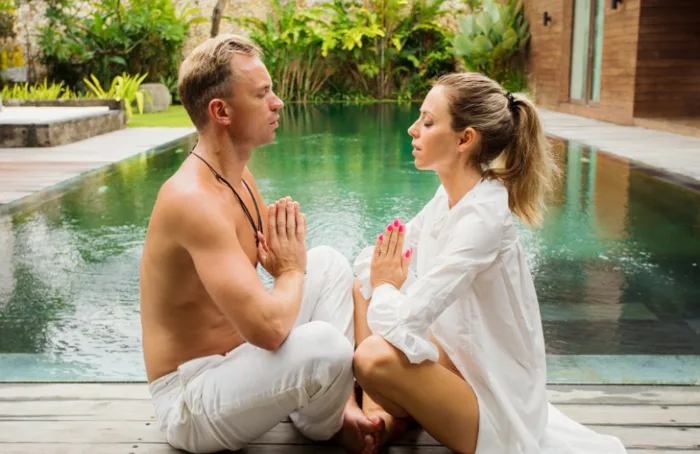
For couples, this can be surprisingly transformative. A simple ritual of sitting face-to-face, breathing together, and taking turns sharing one desire and one boundary can create more closeness than trying a new technique while avoiding the real conversation.
Tantra includes the whole emotional landscape
Tantra is not about being blissful all the time. It can bring you closer to grief, anger, fear, longing, and vulnerability because these feelings live in the body too. When we have spent years protecting ourselves from difficult emotions, intimacy can stir them up.
That does not mean tantra causes harm or that every intense feeling is a sign to keep going. It means emotional responses deserve care. If a practice leaves you overwhelmed, numb, panicked, or disconnected from yourself, slowing down is wise. You may need a simpler practice, a trusted conversation, or support from a licensed mental health professional, especially when trauma is involved.
A safe tantric space does not pressure you to reveal more, feel more, or go further than you want. It honors pacing. It recognizes that healing is not linear, and that “no,” “not yet,” and “I need a break” can be powerful expressions of self-respect.
Breath and energy are tools for expanding awareness
Breath is one of tantra’s most accessible tools because it brings attention back to the present. A slower exhale can help settle the nervous system. Breathing into the belly can make it easier to feel grounded. Sharing a few calm breaths with a partner can create a sense of rhythm before touch begins.
You may also hear tantra speak about sexual energy or life-force energy. Some people experience this language spiritually, while others understand it as a useful way to describe arousal, vitality, emotion, and focused attention moving through the body. You do not have to adopt a particular belief system for the practices to be valuable.
The practical point is to avoid narrowing your attention to one goal or one body part. Notice your whole experience: breath, heartbeat, muscle tension, warmth, emotion, imagination, and connection. When arousal is allowed to build gradually rather than being forced, it may feel more spacious and less demanding.
This is also why tantra is often associated with practices such as edging, pelvic floor awareness, sensual massage, and orgasmic breathwork. These practices can be powerful, but they are not requirements. Their value depends on your intention, your comfort, and the quality of consent and communication involved.
It invites devotion to your own truth
Tantra does not ask you to become someone more exotic, endlessly available, or sexually adventurous than you are. It asks you to become more honest. That honesty may lead you toward bolder expression. It may also lead you toward slower dating, clearer agreements, celibacy for a season, or a renewed relationship with your own body.
For singles, tantra can become a path of self-intimacy rather than a search for someone else to complete an experience. For couples, it can help shift intimacy away from routine and toward shared discovery. For experienced practitioners, it can offer a reminder that advanced practice is not about intensity alone. Depth often lives in the smallest moments of attunement.
At YouTantra, the most meaningful learning happens when knowledge becomes lived experience: one conscious breath, one honest boundary, one moment of receiving yourself with less judgment. You do not need to force a transformation. Begin by giving your body a little more time to tell the truth, and let that truth guide the next gentle step.