.png)
.jpg)

Heal Intimacy Anxiety Through Embodiment

A loving touch can feel like too much when your nervous system is braced for disappointment, pressure, judgment, or loss of control. You may deeply want closeness, yet find yourself going numb, overthinking, pulling away, or performing what you believe a partner wants. To heal intimacy anxiety through embodiment is not to force yourself to relax or become more sexual on demand. It is a practice of returning to the body as a place where safety, choice, and pleasure can grow.
Intimacy anxiety is not a personal failure. Often, it is an intelligent protective response shaped by past experiences, relationship patterns, cultural shame, body image, stress, or moments when your boundaries were not fully honored. Your body may be saying, "Slow down. Stay with me." When you learn to listen rather than override that message, intimacy can begin to feel less like a test and more like a shared experience.
What intimacy anxiety can feel like in the body
Anxiety around intimacy does not always look like panic. It can be subtle: a tight jaw when someone kisses you, shallow breathing as clothes come off, a racing mind during sex, or an urge to please before you have checked in with your own desire. Some people lose sensation. Others become hyperaware of every perceived flaw, every sound, every pause.
You might feel warm and connected during conversation, then suddenly distant once touch becomes more erotic. You might want intimacy in theory but feel resistant when it is available. You may also notice a pattern of choosing partners who feel emotionally unavailable because distance seems safer than being fully seen.
These responses deserve gentleness. The goal is not to diagnose every sensation or turn intimacy into a self-improvement project. The goal is to become more present with what is true, one small moment at a time.
Heal intimacy anxiety through embodiment, not performance
Embodiment means bringing compassionate attention to your lived physical experience. Rather than asking, "Am I doing this right?" you begin asking, "What is happening in me right now?" This shift can be transformative because anxiety thrives when you leave your own experience to manage someone else’s expectations.
Performance-based intimacy focuses on outcomes: staying aroused, reaching orgasm, satisfying a partner, looking desirable, or proving that the relationship is healthy. These desires are understandable, but they can create pressure. Embodied intimacy gives more weight to breath, sensation, consent, emotion, and connection.
That does not mean every intimate moment must be slow, serious, or perfectly regulated. Passion, playfulness, and intensity can all be beautiful. The difference is choice. When your body has room to say yes, no, slower, pause, or more, intensity becomes something you participate in rather than endure.
Begin with sensation outside the bedroom
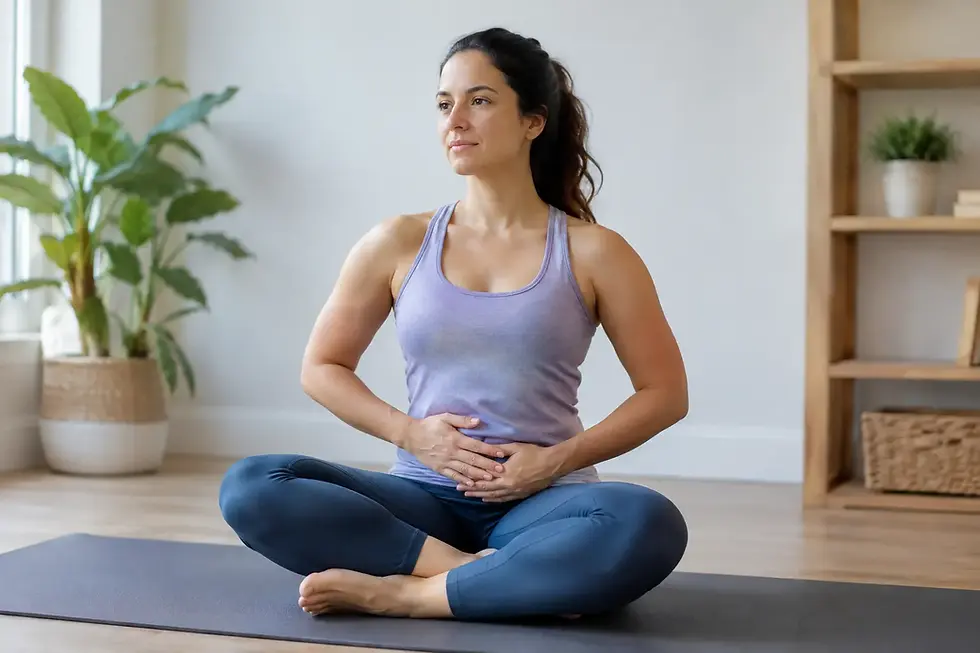
If your nervous system associates touch only with expectations, start somewhere less charged. Place one hand on your chest and one on your lower belly for a few breaths. Feel the temperature of your palms, the rise and fall beneath them, and the support of the surface under your body.
You can also practice sensing pleasure in ordinary moments: warm water on your hands, sunlight on your face, the scent of tea, a song that softens your shoulders. This may sound simple, but it teaches the body that sensation can be received without needing to lead anywhere.
Try asking yourself, "What would feel nourishing for the next thirty seconds?" The answer might be stretching, drinking water, putting on a soft shirt, or doing nothing at all. Small acts of attunement build trust with yourself.
Let your exhale lead
When anxiety rises, the body often prepares for threat by tightening and speeding up. You do not need to command yourself to calm down. Instead, experiment with making your exhale a little longer than your inhale. For example, inhale naturally, then breathe out slowly as if you are warming your hands.
Do this before a date, before a vulnerable conversation, or during a pause in physical intimacy. Notice whether your shoulders lower, your belly softens, or your attention returns to the present. A single breath will not erase a history of fear, but it can create a little more space between sensation and reaction.
Make consent an ongoing source of safety
Consent is not a one-time question asked at the beginning of an encounter. It is a living conversation with yourself and, when relevant, with your partner. Embodied consent includes noticing whether your yes feels open, settled, curious, hesitant, or absent.
Practice language that is clear and kind: "I want to stay close, but I’d like to slow down." "Can we pause for a minute?" "I love kissing you. I’m not ready for more tonight." "I’m not sure what I want yet, but I want to stay connected."
A caring partner may have feelings about a boundary, but they are responsible for managing those feelings without coercing you. Your comfort should not depend on being endlessly agreeable. In fact, relationships often become more intimate when both people learn that honesty is welcome.
If you are partnered, consider creating a simple check-in before touch. Ask what each person wants more of, what feels off-limits today, and what would help them feel cared for if emotions arise. This can feel awkward at first, especially if you are used to reading signals and hoping for the best. With practice, it becomes a form of tenderness.
Expand your definition of intimacy
When sex is treated as the only proof of connection, every encounter can carry too much weight. Embodiment invites a wider field of intimacy: eye contact, shared breathing, massage with clear agreements, holding hands, honest conversation, bathing together, affectionate touch, or simply resting near one another.
Choose an experience with a clear beginning and end. You might agree to ten minutes of clothed cuddling, with no expectation that it will become sexual. Or offer each other a hand massage, checking in about pressure and pace. Structure can help anxious bodies relax because the container is known.
For some people, nonsexual touch feels easier. For others, touch of any kind may be activating. It depends on your history, your relationship, and how safe you feel in your body that day. There is no hierarchy of progress. A boundary honored is often more healing than a boundary pushed.
Meet the thoughts with compassion, then return to the body
Intimacy anxiety often comes with a loud inner narrator: "I look strange." "They’re bored." "I’m taking too long." "I should want this more." Arguing with these thoughts can sometimes make them louder. Instead, name them gently: "I’m having the thought that I need to perform." Then bring attention back to a concrete sensation, such as your feet, your breath, or the feeling of a hand resting on your arm.
If it feels supportive, share a small piece of your inner experience with a trusted partner. You do not need to disclose your entire history in the middle of an intimate moment. Even saying, "I’m feeling a little in my head. Can we slow down?" can interrupt the loneliness that anxiety creates.
When extra support is part of the path
Embodiment practices can be powerful, but they are not a replacement for trauma-informed professional care. If intimacy brings flashbacks, dissociation, panic, pain, compulsive behavior, or a sense that you cannot choose freely, working with a licensed therapist or qualified sex therapist can offer essential support. If there is current coercion, abuse, or fear in your relationship, prioritize safety and outside help rather than trying to solve it through better communication alone.
Healing also rarely moves in a straight line. You may feel beautifully open one week and guarded the next. This does not mean you are back at the beginning. It may mean your body is revealing another layer that needs patience, rest, or care.
The most intimate promise you can make is not that you will always be ready. It is that you will keep listening. Each time you honor a pause, breathe through a wave of uncertainty, or tell the truth about what you need, you teach your body that closeness does not require abandoning yourself.


Comments